Wednesday, February 18, 2015

Number Talk

A Brief Background on Number Talks:

Kathy Richardson and Ruth Parker began giving teachers mental math exercises at professional development settings during the 1990s. As these teachers completed more mental math Kathy saw the teachers becoming more proficient. Kathy and Ruth realized that they wanted to develop students' understanding, but they did this best by using concrete models to figure out computation. This idea lead to number talks. 

So...what is a number talk? A number talk is a short daily routine that gives students meaningful practice with computation. Number talks help students develop fluency while solving mental math problems. One great way to introduce a number talk is after a counting circle. In case you haven't heard of a counting circle here are some blogs to check out:

 Sadie Estrella - Counting Circle
 Malke Rosenfeld - First Counting Circle
 John Golden - Sadie's Circles 

I would love to explain in detail what exactly a number talk is but Jo Boaler does a beautiful job (way better than I ever could) in this video, it is worth the watch!


Here are my Top 5 Benefits of Number Talk:

1. Teaches Number Fluency 
This is in my mind the greatest benefit of number talks. The more students are involved in number talks the deeper conceptual understanding they have about numbers. Students will begin to see different fact strategies for addition, subtraction, multiplication, and division the more they practice. They will then use these known facts be able to see things like 6+7=6+6+1 or 6+7=7+7-1. Students show their fluency when they are able to explain why they are doing what they are doing, and also when they know how to solve a problem using different methods. 

2. Number Talks Build Confidence in Students
Once a student has a deeper conceptual understanding of numbers and how they work they will start to solve mental math problems at a faster pace. It might not happen right away, but the more practice a student has the faster they will get during number talks. This gives our students confidence. They can feel that they are becoming more proficient. I know that this confidence will carry over into their mental attitude while solving other math problems. 

3. Students Learn Different Strategies 
Sometimes a student will solve a problem in a way that other students would have never thought of. By sharing these idea in the form of a number talk our students gets to collaborate and may learn a more effective way of solving mental math problems. You may hear students say things like "Oh I never thought of that!" That is one of my favorite sentences! This means that our students are recognizing that other students think differently than them and that they have valuable ideas to share as well. Even the teachers have valuable things to learn from their students. 

4. How to Make a Problem Easier to Solve
Which is the easiest to solve? 
13-7?
12-6?
11-5?
10-4?
Chances are that students would struggle more when presented with 13-7 versus 10-4 or 12-6, but the awesome part is they all equal 6! During number talks students begin to see that they can change the problem they are working on to make it easier on themselves. If a student gets uncomfortable solving a certain problem they can change that problem into something easier using their fact strategies! One student might struggle trying to solve 46-29 mentally, but once they see that 46-29=50-33 they might have an easier time solving this problem mentally. Its important for students to be able to make mental math easier for themselves. 

5. Teaches Students Communication
How do we expect our students to be able to communicate about mathematics if they never practice? At first students will struggle trying to explain their thinking during a number talk but the more practice they get the more articulate they are and the more thorough they are in their explanations. One of the 8 Mathematical Practices of the Common Core is for students to be able to "Construct Viable Arguments and Critique the Reasoning of Others". This means that students need to be able to communicate about math, using mathematical language. Number talks are a great way to get our students on the track of mathematical communication, which leads to deeper conceptual understand and fluency, look at that its like a cycle!

Last semester I wrote an article about math anxiety and counting circles. I talked about how nervous I felt during counting circles and how I basically dreaded doing them in class. I can honestly say now that I enjoy counting circles. I enjoy them because of how much the number talks have helped me. Over the last two semesters I have deeper understanding of numbers and better number fluency. Counting circles no longer make me so anxious because I have different strategies to solve mental math problems. I will 100% do regular number talks in my future classroom because they will do nothing but help my students in the long run and make them better mathematicians. 


To Flip or Not to Flip

Flipped classrooms are a hot topic in education today. Many teachers believe that they can do more meaningful mathematics when they use technology to support their students' learning. The idea of a flipped classroom is that the students will learn the content, that normally would be taught with a lecture style, outside of the classroom with the use of technology. This then allows the teacher to be able to use class time doing activites that apply the students' knowlege. Normally students will learn the material by using a combination of videos and coinciding worksheets. These worksheets are normally checked and counted as a "homework" grade. Other teachers may use quizzes at the beginning of class to keep their students accountable for watching the videos the night before.

One of the struggles of teaching is that not all students learn at the same speed or in the same way. While some students may succeed in a traditonal classroom setting, other students may fall behind. The flipped classroom model allows students to rewatch the videos multiple times if they are not grasping a concept on the first try. Also by watching the videos before the next class students can come to class with questions, some teachers even put a spot on their guided worksheets for such questions. 

Having students learn the material independently also allows teachers to give students more individual support. Since class time in a flipped classroom is used to do activites, the teacher is then able to walk around the room and get immediate feedback about where their students are as far as understanding the content. Therefore, if a particular student is struggling then their teacher can spend one-on-one time addressing their questions.


In the Februrary 2014 issue of Mathematics Teacher there was an article about flipped classrooms. Two teachers, Amanda Moore a 7th grade math teacher from Battle Creek, MI and Matthew Gillett an 8th grade math teacher from Armada, MI, observed the effects of flipping their classrooms. Both teachers saw homework (watching instructional videos and completing guided notes) completion rate rise, with one class even increasing by 19%. After doing a unit of flipped instruction both teachers agreeded that by flipping their classrooms student engagement increased in class and they also said they had more time to do meaningful mathematics. The homework completion rate indicated that more students were doing mathematical work outside of school, and students were also engaging in more problem solving in class that previously was provided through homework. 

The last two semesters I have volunteered in Tara Maynard's 8th grade math classes in Zeeland Public Schools. Mrs. Maynard uses a flipped instruction model in her classroom, so I have been able to see the benefits of flipping first hand. Mrs. Maynard uses videos that she makes (with her own voice using an app called ShowMe) for her students' instruction. The students in Mrs. Maynard's class can access these videos without the use of internet at home through their iBooks app on their iPads (Zeeland Public Schools are 1:1). Mrs. Maynard also provides the students with a note packet to complete while they watch the videos. 

Here is what Mrs. Maynard says are the benefits of flipped classrooms:
- She gets to have conversations with everyone of her students everyday
-Truly know what the students understand and what they haven't yet grasped
-There is more time to do explorations, activites, demonstrations, labs, and deeper questions
-Students are able to move at their own pace and learn with their own style
-Supports anywhere anytime learning
-Parents can't give the excuse of "I can't help"

As with everything in life there are also some negatives to flipped classrooms as well. Here are some of the things Mrs. Maynard says she struggles with:
-Time (creating videos, creating activities etc.)
-Still giving paper and pencil assessments
-If its just a video and a worksheet it is not flipped instruction
-Videos can be done wrong (bad lecture, too long, boring, etc.)
-Students still come to class unprepared and waste time

Here is a video of a typical day in Mrs. Maynards flipped classroom.


Mrs. Maynard also asked her students what they thought of learning in a flipped classroom, here are their thoughts.

Almost all of the teachers who have flipped classrooms can agree that students are able to engage more in the mathematics they are learning. While flipped classrooms might have some downfalls I believe the positives outweigh the negatives. I would love to some day use a flipped model for my own classroom. I think that flipped instruction can provide so many learning opportunities for students and isn't that why we are teaching to begin with? 

Tuesday, January 27, 2015

Fears of a Future Teacher

Well I am going to be honest, I have had a very hard time writing this blog post. Each idea I came up with just didn't feel right, I would start writing and then lose interest in what I was writing about. I think my writing block came from some stress I have been experiencing lately. This last Thursday I turned in my application for the College of Education. All of a sudden everything felt so real to me. I realized soon I will be responsible for teaching students. This terrifies me. I worry whether I will be prepared for the challanges that are ahead of me. Then I realized I wasn't alone.

I, along with over 11 million other people, read the the blog Humans of New York. (In case you haven't read Brandon's blog I would suggest you take a look https://www.facebook.com/humansofnewyork) The other day I read a post that stopped me in my tracks. Over the past week Brandon has been focusing on a school called Mott Hall Bridges Academy. He has talked to the principle Ms. Lopez, students in the school, and also the Mott Hall Bridges teachers. Below is the post about a converstaion a teacher, Ms. Powell, had with Brandon that really resionated with me. 


All of a sudden I realized that Ms. Powell had summed up all of my fears about teaching. Recently I have heard all about the gaps in the education system, how students can be multiple grade levels behind by the time they reach your classroom. My biggest fear is that I will not be able to help my students be successful. How can I teach my students to factor polynomials if they have limited multiplication skills? As a teacher I know I will always have more material to cover than I have time to cover it in. These students who come to me grade levels behind need so desperatly to be successful, but where will I find the time to fill in the gaps? I am sure this is one of the biggest stuggles amoung teachers, and it cannot be fixed overnight.

I think the work of a prepared teacher starts long before they ever step foot in a classroom. My work as a teacher begins now. I am learning the skills and practices of successful teachers, but in my opinion the most important tool I can have as a teacher is collaboration. There are thousands of other teachers in this country who have the same fears I do, and they face them on a daily basis. They are my most valuable resource. Its important that I learn to ask them questions and learn from them. 

We teachers are a team, that needs to work together. We all have the same goal, we want our students to be successful. At times my fears about becoming a teacher can be overwhelming, and I think that I am not cut out for this. Then I realize all of all of teachers I look up to, that inspire me, have all had the same fears. They have had sleepless nights worrying about how they are going to fit in all of their material, and they have experienced the joy of watching a student finally understand something they were stuggling with. I am terrified to become a teacher, but I know as long as I have thousands of other teachers ready to help me in my journey, I will be alright. 

Tuesday, December 9, 2014

'Twas the Night Before Exams

‘Twas the night before Exams and all through my room,
I sat quietly awaiting my ultimate doom.
The pencils were placed in the backpack with care,
In hope that at the paper I just wouldn't stare.
The students were nervous all stiff in their chairs
While visions of failure hung in the air.

And the teachers with their Scantrons and I with my note cards,
Prepared for a day that was sure to be hard.
When books began to fall creating a clatter,
My teacher looked up asking what was the matter?
Frustration had built inside of my body,
I responded to her trying not to be snobby.

Then what with my wandering eyes should I see?
My clock blinking bright, twelve thirty-three.
A full night’s rest, surely not ahead,
I crawl to the couch, resting my head.
Hours passed by filled with cartoons and news,
But this was not curing my exam day blues.

Go math! Go english! Now physics! Spanish two!
Everything chemistry and anatomy too!
All Gen Ed classes, no matter how small,
Go away! Go away! Go away all!
All folders filled with useless review
All protractors, pens, and everything due.

As I began to drift off, finally calming down,
Thinking of the future made me frown.
I prayed I would not sleep through my alarm,
Surely a snow day would cause no harm.
My eyes-how dull! My hair balled in a mess!
As morning drew near I tried hard not to obsess.

I tumbled out of my cave, my stomach filled with fear.
I am not ready for this oh my, oh dear.
And grabbing my backpack with nerves in my belly,
I embarked on my journey, my legs just like jelly.
All of this panic filling my head,
Soon developing a new feeling of dread.

Last minute cramming would do nothing to alter,
Should have studied but knew I would falter.
With a switch of the light and a quick little sigh,
I trudged to school, kissing my good grades good-bye.
The teachers passed out the intimidating tests,
All I could think is, I should have gotten some rest.
Then I yelled to my peers, with a loud hearty cry,
Happy exams to all, kiss your GPA good-bye! 

Saturday, November 22, 2014

What is a Radian?

Last week I spent some time reviewing what the CCSS say about trigonometric functions. As I was reading I came across a standard that made me pause.

CCSS.MATH.CONTENT.HSF.TFA.1: Understand radian measure of an angle as the length of the arc on the unit circle subtended by the angle.

So I'll be honest, radians are still a bit mysterious to me. So I did some digging around in Sameer Shah's Virtual Filing Cabinet, and I came across Kate Nowak's blog post encouraging teachers to ask their students "what is one radian?" I then decided that I would write a post doing by best job to explain what is one radian.

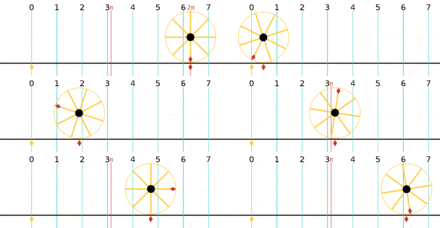
Roger Cotes is credited for the concept of radian measure in 1714, however the term radian did not come about until 1873. The radian is considered the standard unit of angle measure. Radian measure depends on arc measure on the unit circle.

The measure, in radians, of an angle subtended by a circle arc is described as the length of the arc on the unit circle, divided by the radius. Wait...what is an "angle subtended by a circle arc"?


So this means that one radian is the angle subtended by an arc that is equal to the radius of the circle. So in other words an angle with measure 1 radian has an arc length of 1 on the unit circle.


An angle with radian measure pi (which we know is 180 degrees) has an arc length of 3.14159...Which means there are pi radians in 180 degrees.


So again, one radian is the angle subtended by an arc that is equal to the radius of of the unit circle. 

Another observation that comes from the use of radians is that the circumference of a circle is 2pi times the radius of the circle. The circumference can be thought of as the length of the arc of the entire circle, or as my high school math teacher taught me, the distance it takes to walk all the way around a circle.  So this would mean that the circumference of the unit circle is equal to the radian measure of a 360 degree angle ,  Well we know that the radian measure of a 360 degree angle is 2pi, so that means that the circumference of the unit circle is also 2pi. When we say that the circumference of a circle is 2pi*r, we are really just counting the number of "radii" that make up the exterior of the circle. 


In most mathematics angles are generally measured in radians because radians are more "natural", there are no degrees or meters attached to this measure so this allows radians to be unitless. It is very important that students understand the concept of radian measure, not just because the Common Core State Standards state its important but because using radians makes math easier! Trigonometric functions are defined by ratios in the same way radians are defined by ratios, so it only makes sense to use radians while working with trigonometric functions. However, it is important that students have a deep understanding of radians before they begin to work with them, it is important for students to know exactly what a radian is. When students have conceptual understanding of ideas like this it will only help their understanding of other mathematical concepts. 


Monday, November 3, 2014

Enrico Fermi and Walt Disney

So for those of you who don't know already, I love Disney. Those closest to me might even call me obsessed. I even have a Mickey Mouse tattoo and a tattoo with the coordinates to Cinderella's Castle in Magic Kingdom. Ok, so I will admit it....I am obsessed. Last weekend I took my 17th trip to Walt Disney World in Orlando to celebrate Halloween and enjoy Disney's Food and Wine Festival. While I was in Disney I of course discovered new rides and new shows that I had never even seen before, each time I go down I am amazed at how much of WDW I still have yet to experience. So this got me thinking, how many days would it take to do everything in WDW?

So in case you are not very familiar with Disney World, here are some facts for you:

  • On Disney property there are 4 amusement parks (Magic Kingdom, Animal Kingdom, Hollywood Studios, and Epcot), two water parks, a shopping district (Downtown Disney), and 34 different resorts, all which total 27,258 acres (42.59 square miles). 
  • 50,125,000 people visited WDW in 2013
  • In the 4 main amusement parks there are 71 different rides and shows


So now that I have decided to tackle my Disney Fermi problem, my next step was figuring out what "doing everything" means to me. I decided that this would mean riding every ride and watching every show (a show being some sort of entertainment that I would watch that was not a moving ride) in all four of the main parks. I decided to exclude watching parades and fireworks because those vary depending on the day and also the time of the year. I also excluded anytime spending shopping. So next I figured out what information I would need to solve this problem, and this is what I decided was important to know:
  • Average wait time for each attraction (I used a 10 minute wait for each show)
  • Ride length for every ride and the run time for each show
  • Average time spent walking from ride to ride
  • Time spent getting to the park (I used the Disney bus system because it is provided for free for people who stay at a Disney resort)
  • Time getting into the park and leaving the park
  • Time spent eating
  • Park hours for each of the four parks
Note: I decided that for all of my approximations I would round up my values to account for bathroom breaks, longer than average wait times,  crowds etc. 

So most all of this information I was able to find online. I even found a website that lists the exact times for each ride and show in WDW. Another cool website I found complied average wait times for every ride depending on the crowd. Information I was not able to find online I just estimated using my experience of my many trips to the parks. So once I collected all of this information I compiled it into one huge spreadsheet and then began to add everything up. 

Except it wasn't that easy. I decided that I would figure out how many days it would take to complete each park first and then add all of those days together. Some parks took longer than one day to complete so on those extra days I had to add extra time for eating and travel time. This was the formula I used to calculate the number of days each park would take.

# of Days = [Travel Time + Time Spent Entering Park + Meal Time + Total Average Wait Time + Total Ride Time + Time Spent Walking] / [Park Hours]

Then if the number of days was greater than one I added more travel time, time entering the park, and meal time accordingly. 

After all of my calculations I came up with these values for the number of days it would take to do everything in each park:
  • Magic Kingdom: 2.462 days
  • Hollywood Studios: 1.26 days
  • Epcot: 1.65 days
  • Animal Kingdom: 1.26 days
 This means that it would take roughly 6.63 days to ride every ride and watch every show that WDW offers. Based on my experience I figured that my answer would be close to a week once I figured in the park hours, travel time, etc. Then I began to wonder how much it would cost to take this trip to Disney to do everything. So then I began another hunt for more information. I decided I would estimate this seven day trip using a family of four (I figured this was a common family size). 

These were the expenses I found:
  • 4 round trip plane tickets from Grand Rapids to Orlando: $1,836.80
  • 8 night stay at Disney's Caribbean Beach Resort: $1,781.68
  • 7 days worth of admission to WDW: $1,358.94
  • Cost of food (I used the Disney Dinning Plan estimate): $464.16
So to take your family of four to ride every ride and see every show in WDW it would cost roughly $5,441.58. And this doesn't even include any shopping. So after spending time working on this problem I decided to make myself a Disney checklist, and it is my current goal to finish this checklist. I guess that just means I have an excuse to visit my favorite mouse another time! 


Wednesday, October 15, 2014

Math Anxiety in the Classroom

My palms are sweaty, I feel nervous, my heart is racing, and I have completely forgetten how to do basic math...it must be time for a counting circle. I tell my self that I learned how to add and subtract numbers in grade school so counting in a circle with my peers should not be a challange for me, yet it always is.

Here is a quick description of the concept behind counting circles. To begin you start with a number on the board, it can be any number (positive, negative, even fractions). Then there is a number that you must count by, again this can be any number. So for example one counting circle we might start at 327 and count by -62, or another counting circle we might start at 3/7 and count by 1/9. The part that makes this a counting circle is that everyone in the class is standing in a circle and we all take turns saying the next number in the count. So the first person to start will say the first number (eg. 327+-62=265) and then the next person will count from there (eg. 265+-62=202) and so on until we have gone around the circle a few times. 

It is all just basic math that I, as a math major, should feel comfortable doing but each time a new counting circle starts I feel the same pit in my stomach, the sweaty palms, the fear of making a mistake. Even though in our classroom there is no pressure to get the correct answer (if someone is incorrect the circle keeps going from whatever number they said right or wrong) I still feel so much stress over these circles. So I decided to do some research on math anxiety. 

Students who have such a lack of confidence in their math ability that it actually affects their academic performance are said to have math anxiety. Most students feel anxiety especially in math class because in math there are so many different concepts that are completely foreign to them. A study by the University of Granada in Spain did research on 855 first-year college students with 23 different degrees that all require mandatory math classes. The found that 60% of those students had some for of math anxiety. Of those students who experienced math anxiety 47% were men and 62% were women.                                                                                                                                                                                                                                                                                    

Math anxiety and being "bad at math" are two different things, math anxiety produces physical and psychological responses in students when they are presented with math problems. Students who have math anxiety can experience nausea, shortness of breath, sweating, heart palpitations, and increased blood pressure when they are presented with math problems. They can also experience psychological symptoms such as memory loss, paralysis of thought, loss of self-control, negative self-talk, math avoidance, and isoslation. Standford University scientists say that the brain function of young adults who have math anxiety is different that those who don't. They conducted functional magnetic reasonce imgaing on the brains of 2nd and 3rd graders as they worked on math problems. They found that students who experienced math anxiety had increased brain activity in areas associated with fear and decreased activity in the part of the brain associated with problem solving. Other studies have also shows that math anxiety disrupts the working memory of students (The working memory of the brain is very important for problem solving). 

After finding all of this research and reading though articles I realized how important the problem of math anxiety is to us as teachers. How can we expect students to be able to problem solve when science shows decreased activity in that part of the brain if students have math anxiety? Math anxiety is a real problem in classrooms and can effect the success of our students. Some ways that we can help as teachers is to make sure that we are confident in our own math ability. If we are having some form of math anxiety our students can feel that and may be more likely to pick up on those anxieties. We can also help by making sure we know which students may experience some form of math anxiety.   There are surveys and questionaires (eg. Fennema-Sherman Mathematics Attitudes Scales) that can asses levels of math anxiety in students. If we are aware that some students have higher anxiety than others we will be better able to help those students (such as finding them a tutor, giving extended time on a test, extra practice problem etc). 

Math anxiety is a real problem and we will most likley be faced with this problem a lot as teachers. It is very important to make sure that we have the tools to help our students. There are a lot of resources out there on math anxiety, being aware of the problem is the first step to a solution. 

References: 

"Math Anxiety." Gifted Child Today (2007). Print.

Thilmany, Jean. "Math Anxiety." Mechanical Engineering (2009). Print.

"Math Anxiety: The Neurodevleopmental Basis of Math Anxiety." Education Week (2012). Print.

Bohrod, Nina, Candance Blazek, and Sasha Verkoutesva. "Math Anxiety." Anoka-Ramsey Community College . Print.